
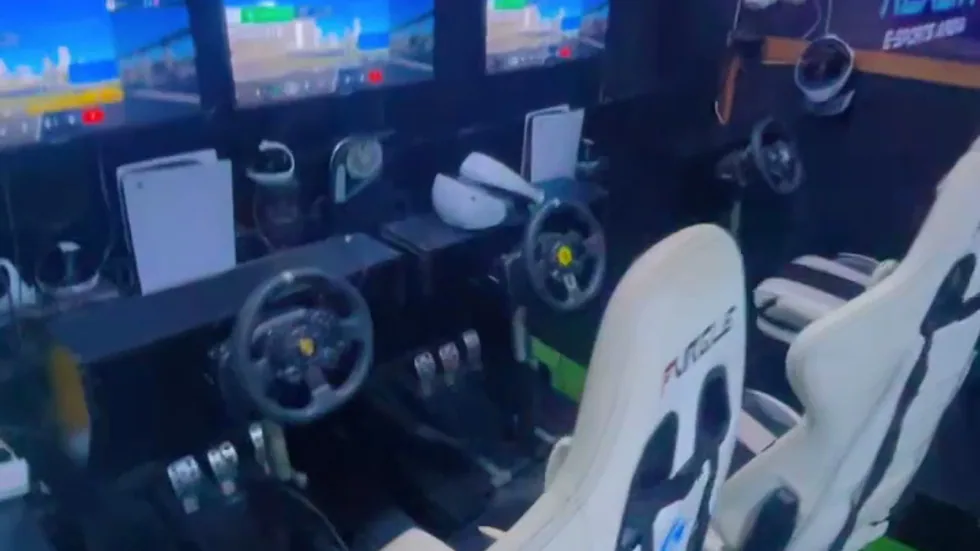
Racing simulators are one of the strongest attractions in a modern game cafe because they are easy to understand, exciting to watch, competitive, and suitable for many types of customers. At Player One Game Cafe, racing experiences have shown us that not every successful game attraction needs a long explanation. People understand racing immediately: drive fast, beat the time, challenge your friend, and try again.
That simplicity is powerful.
1. Racing is easy for almost everyone to understand
Some games require deep knowledge. Some customers do not know controls, characters, or rules. Racing is different. Most people understand steering, speed, crashing, overtaking, and finishing first.
This makes racing simulators attractive to:
- First-time visitors
- Friends
- Couples
- Corporate teams
- Car lovers
- Kids and teens
- Adults who do not see themselves as gamers
- Brand activation guests
- Event attendees
A customer does not have to be a professional gamer to enjoy racing.
2. Racing creates natural competition
A good game cafe needs experiences that make people challenge each other. Racing does this naturally. People want to know who is faster. They want to beat the previous time. They want another try.
This creates repeat play.
A simple leaderboard can turn one racing setup into a reason for customers to return. You can create:
- Fastest driver of the day
- Fastest driver of the week
- Branch leaderboard
- Birthday group challenge
- Corporate team challenge
- Brand-sponsored racing challenge
- Student racing league
Competition increases engagement and gives the business content to post.
3. Racing is visually attractive
Racing setups look good in photos and videos. A customer sitting in a cockpit with a steering wheel and screen already looks like an experience. This makes racing useful for social media and content creation.
For a game cafe, visual experiences are important because customers often decide to visit after seeing videos online. Racing simulators help show that the space is more than ordinary console gaming.
4. Racing works for events
Racing is one of the easiest gaming experiences to take into events because it can be structured as a challenge. Guests do not need to play for long before they understand it.
At an event, you can run:
- Fastest lap challenge
- Brand-sponsored leaderboard
- Head-to-head racing
- VIP racing session
- Kids racing corner
- Corporate team race
- Product launch activation
This makes racing simulators useful for off-site rentals, brand activations, mall events, school fun days, corporate open days, and private parties.
5. Racing is strong for brand sponsorship
Brands like experiences that attract attention and produce shareable moments. Racing can do that.
A brand can sponsor:
- Fastest Driver Challenge
- Racing leaderboard
- Racing booth
- Prize challenge
- Campus racing tournament
- Corporate racing day
- Product demo with racing
For beverage brands, tech brands, sportswear brands, automotive brands, youth brands and entertainment brands, racing can provide a clean and measurable activation idea.
6. Racing helps with group rotation
In a busy game cafe, not everyone can play the same game at once. Racing works well as part of a rotation system. While some customers are playing VR or PS5, others can race, watch, cheer, record, or wait for their turn.
This helps with birthdays, school trips, team bonding and group bookings.
A good group session can combine:
- VR Arena
- Racing simulator
- PS5 battle
- Karaoke/social games
- Photos/videos
- Leaderboard challenge
Racing becomes one part of a larger social experience.
7. Racing equipment must be protected
Racing simulators are exciting, but they are also physical. Customers pull, turn, hit, push pedals, and sometimes play aggressively. This means the business must protect the equipment.
Important operating rules include:
- Staff briefing before play
- Clear instructions on handling wheels and pedals
- No rough handling
- Staff monitoring
- Daily equipment checks
- Damage policy
- Proper mounting and cabling
- Stable seating/cockpit
The more physical the experience, the more important the operating system becomes.
8. Racing can justify premium pricing
A racing simulator feels more premium than normal screen gaming because it is physical, immersive and competitive. Customers can see the value immediately. That makes racing useful for premium packages, group bookings and events.
It can also support equipment partnerships because racing gear brands can place products in a real environment where customers actually use them.
Final thought
Racing simulators can drive engagement because they combine simplicity, competition, visual appeal, event usefulness and repeat play. For a game cafe, that is a powerful mix.
At Player One, racing is not just a game; it is a content tool, a competition tool, an event tool and a business growth opportunity.